


Creating Better Facial Balance: Rhinoplasty and Chin Augmentation Case Study
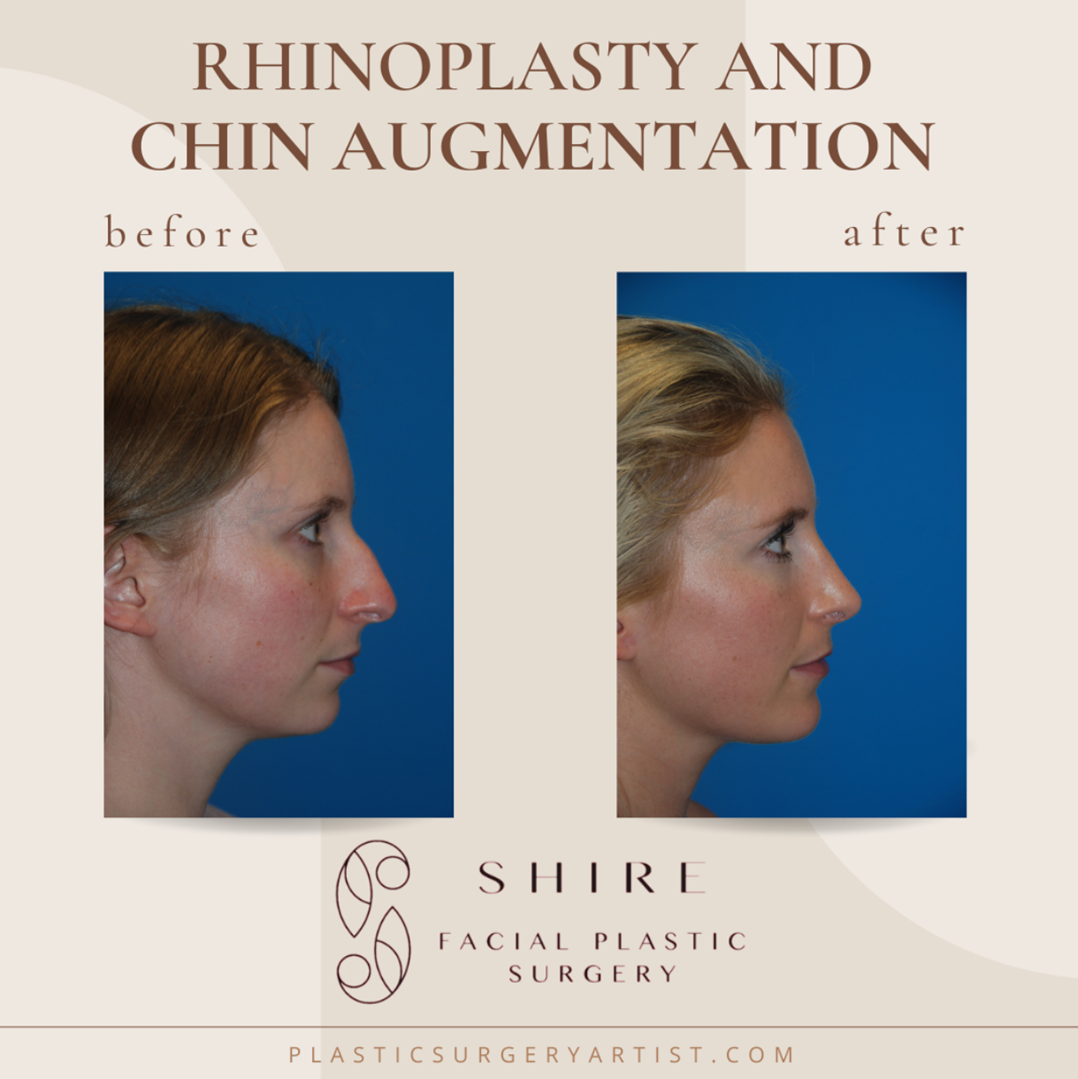
This case study describes one Chattanooga patient’s facial balancing surgery with Dr. James R. Shire, a facial plastic surgeon at Shire Facial Plastic Surgery. The patient’s main concern was that her nose appeared too large for her face, but Dr. Shire’s consultation showed that nasal shape and chin projection both influenced her profile.
Case Snapshot
- Procedure: Open rhinoplasty and chin augmentation
- Primary concerns: A projecting nose, dorsal hump, slightly drooping nasal tip, rounded tip with limited definition, and a mildly recessed chin
- Functional note: The patient felt her nose appeared too large for her face, but facial analysis showed that chin projection also contributed to the overall profile imbalance
- Surgical support: Open rhinoplasty was used to lower the dorsal hump, refine the nasal tip, improve tip position, and create a smoother nasal contour; chin augmentation was used to add lower-face projection
- Overall goal: A more balanced facial profile with a refined nose, stronger chin projection, and natural-looking harmony between the nose, lips, chin, and jawline
Patient Concern
The patient came to Dr. Shire because she felt her nose looked too large. Her concern was focused on the nose, which is common for patients who are trying to understand why their facial profile feels out of balance.
During facial analysis, Dr. Shire identified several nasal features that contributed to the concern, including a dorsal hump, a slightly drooping tip, and a rounded, less-defined nasal tip. He also noted that the patient had a mildly recessed chin. In this case, the chin position made the nose appear more prominent because the lower face did not provide enough projection to balance the profile.
Why Facial Balance Mattered in This Case
A rhinoplasty in Chattanooga can refine the nose itself, but the surrounding facial structure can affect how large or balanced the nose appears. For this patient, Dr. Shire did not recommend treating the nose in isolation. He planned the surgery around the full profile, including the relationship between the nose, lips, chin, and jawline.
That broader analysis helped create a treatment plan designed to make the nose look more proportional instead of simply making it smaller.
Consultation and Surgical Plan
The surgical plan focused on improving the patient’s facial proportions while keeping the result natural for her existing features. The goals of surgery were to:
- Reduce the dorsal hump along the bridge of the nose.
- Refine the rounded nasal tip and improve definition.
- Rotate the nasal tip into a more balanced position.
- Add chin projection to improve the lower-face profile.
- Create a profile that looked more harmonious without appearing artificial or overdone.
By addressing both the nose and chin, Dr. Shire could improve profile harmony in a way that rhinoplasty alone may not have achieved for this patient.
Procedures Performed
This patient underwent open rhinoplasty and chin augmentation.
Open Rhinoplasty
Using an open rhinoplasty approach, Dr. Shire was able to precisely reshape the nasal structures. The procedure lowered the dorsal elevation, refined the nasal tip, and rotated the tip into a better position. This approach also supported more controlled nasal tip refinement, which was important because the patient’s tip was rounded and lacked definition.
The rhinoplasty portion of surgery focused on:
- Dorsal hump reduction
- Nasal tip refinement
- Tip rotation and elevation
- Improved nasal definition and contour
Chin Augmentation
To improve facial balance, Dr. Shire also performed chin augmentation to increase the projection of the lower face and strengthen the jawline. While the rhinoplasty improved the shape of the nose, the chin augmentation helped bring the lower face into better proportion with the nose, lips, and overall profile.
In this case, the chin augmentation was an important part of the final result because it changed how the nose related to the rest of the face. With improved chin projection, the nose appeared more balanced and appropriately sized within the patient’s profile.
Recovery
The patient recovered well from surgery. As swelling gradually subsided, her new facial profile began to emerge. The draft source material does not provide a detailed recovery timeline, so this case study avoids adding unsupported milestones, restrictions, or return-to-activity claims.
In general, rhinoplasty refinement can continue as swelling improves over time, and every patient’s healing process is different. Patients should follow their surgeon’s specific post-operative instructions and attend recommended follow-up visits.
Results
This case demonstrates an important principle of facial plastic surgery: improving the appearance of the nose sometimes requires evaluating the surrounding facial structures as well.
Before Surgery
- Prominent dorsal hump.
- Slightly drooping nasal tip.
- Rounded, less-defined tip.
- Mildly recessed chin.
- Facial profile lacked balance.
After Surgery
- Straighter, smoother nasal bridge.
- More refined and defined nasal tip.
- Improved tip position and projection.
- Enhanced chin projection and jawline definition.
- Better facial balance and profile harmony.
The combination of rhinoplasty and chin augmentation improved the patient’s facial profile while preserving a natural appearance. By bringing the chin into better proportion with the rest of her face, the nose appeared more balanced and appropriately sized. According to the case source material, the patient was extremely happy with her result.
Why This Case May Be Helpful for Prospective Patients
This case may be useful for patients who are considering rhinoplasty but are unsure whether the nose alone is responsible for their profile concerns. A recessed or underprojected chin can make the nose look more prominent, while improved chin projection may help the face look more balanced from the side.
The American Society of Plastic Surgeons describes rhinoplasty as a procedure that can enhance facial harmony and the proportions of the nose, and describes chin surgery as a procedure that can reshape the chin with an implant or bone reduction. In this patient’s case, those two concepts were combined into one individualized treatment plan.
Schedule a Consultation
To discuss rhinoplasty, chin augmentation, or facial balancing surgery in Chattanooga, contact Shire Facial Plastic Surgery or call 423-870-3223 to schedule a consultation with Dr. Shire.
Disclaimer
This case study describes one patient’s individual experience with rhinoplasty and chin augmentation at Shire Facial Plastic Surgery in Chattanooga, Tennessee, under the care of Dr. James R. Shire. Results are not typical and vary from patient to patient based on anatomy, the specific surgical plan, individual healing, and other factors. This content is for informational and educational purposes only and does not constitute individualized medical advice. Individuals considering rhinoplasty should schedule a consultation with a qualified, board-certified facial plastic surgeon to determine whether the procedure is appropriate for their specific anatomy and goals. Any before-and-after images reflect individual patient outcomes only and do not guarantee similar results.